the reconnection framework
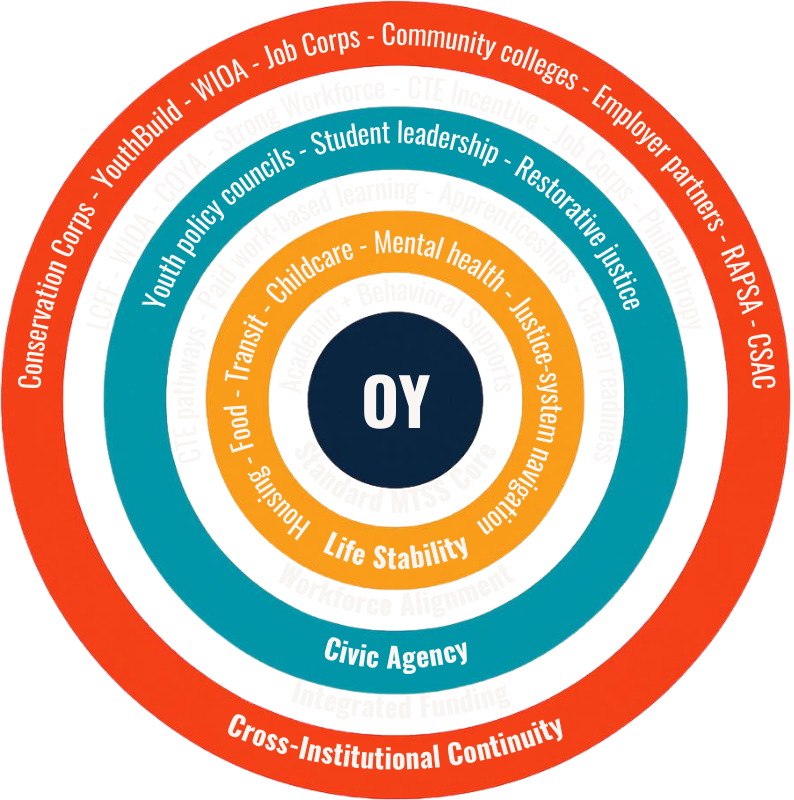
one student. five rings of support.
Read it from the inside out. The student sits at the center. Standard MTSS — the academic and behavioral core — forms the inner ring. Three domains that practitioners have found non-negotiable for opportunity youth extend outward from there: Life Stability, Workforce Alignment, and Civic Agency. The two outermost rings are the structural conditions that make everything else possible: Integrated Funding and Cross-Institutional Continuity. The outer rings are not optional add-ons. They are what make the inner ring work for this population.
Extending California’s
multi-tiered system of support for opportunity youth
MTSS is California's dominant model for supporting students, and it works — for a young person in one school, one funding stream, with one set of adults responsible for their progress. Opportunity youth don't move through the system that way. The Reconnection Framework is OYSC's practitioner-built adaptation of MTSS for opportunity youth. It isn't aspirational: every part of it is already operating at scale across our member schools. We've named it so the field can see it, study it, and replicate it.
MTSS assumes a stable container — one school, one funding source, and a family and community system that absorbs whatever happens outside school hours. Opportunity youth live outside that assumption. They move between schools, programs, and partners, often more than once, before earning a credential. They carry circumstances that traditional schools may treat as out of scope: housing instability, foster-care transitions, justice involvement, parenting, and food insecurity. They're frequently older — 16 to 24 — with adult responsibilities that reshape what "support" can even mean. And they bring lived expertise that the system rarely treats as an asset.
THE CHALLENGES MTSS WASN’T BUILT TO SOLVE FOR
The framework is additive. It begins where MTSS already exists
and extends outward through three domains.
-
Housing, food, transportation, childcare, mental-health access, justice-system navigation. These aren't wraparound services orbiting the real work — they're the precondition for it. Opportunity youth are far likelier than connected peers to lack health coverage, live in poverty, or carry housing instability. Stability predicts post-secondary and employment success more powerfully than poverty alone.
-
DescripCTE pathways, paid work-based learning, apprenticeships, employer relationships, industry-recognized credentials. Opportunity youth arrive seeking a path to income, not a more engaging curriculum. The framework treats workforce alignment as a concurrent ring from day one — not a downstream goal. Unemployment for 20–24-year-olds in this population runs roughly triple that of 16–19-year-oldstion text goes here
-
Student leadership councils, advocacy training, restorative-justice facilitation, civic-engagement credentialing. This ring moves opportunity youth from the subject of decisions to participants in making them — which, for young people who've learned to distrust institutions, is how trust gets rebuilt. Restorative-justice diversion is associated with markedly lower reoffense rates than the traditional court path
the conditions for success
The two outermost rings of the framework are the structural conditions that make everything else possible: Integrated Funding and Cross-Institutional Continuity, and they are what make the rest of the framework work for OY.
integrated funding
No single stream funds this model. LCFF, WIOA, COYA, Strong Workforce, CTE Incentive, Job Corps, YouthBuild, and philanthropy are braided into one coherent student experience. The clearest recent proof is the California Opportunity Youth Apprenticeship grant —
$31M in 2024, $15.4M in 2025, and $13.2M in 2026 — funding 51+ initiatives that blend public and private investment with wraparound services. The integration isn't a back-office detail. It's the model.

cross-institutional continuity
Opportunity youth don't fail to reconnect because services don't exist — they fail because the services don't connect to each other. The seam between institutions is where young people drop. In this framework, partners aren't referral destinations; they're co-located, co-staffed, and co-accountable. Coordinated multi-sector partnerships are associated with a 22% reduction in disconnections in targeted areas compared with single-institution approaches. The partnership structure isn't a complement to the model. It is the model.

start with the framework
Whether you’re shaping policy, leading a county office, funding this work, or covering it — the Reconnection Framework is a practitioner-grounded place to begin.