CASE STUDIES
Our members operate in real schools, with real students.
See how.
Youthbuild charter school of california:
youth policy councils
Youth leadership is not a “nice-to-have.” It’s infrastructure.
The Challenge
Opportunity youth (OY) are often talked about, but too rarely trusted to lead. Across education and workforce systems, decisions are still made for young people instead of with them. Youth voice is treated as symbolic rather than structural, and feedback arrives only after problems have already taken root. When those early signals are ignored, systems miss opportunities for improvement and quietly lose the trust of the young people they’re meant to serve.
When youth leadership is absent:
Programs drift out of alignment with real needs
Disengagement grows quietly, then all at once
Systems spend more money fixing failures than preventing them
When young people feel invisible, systems lose credibility. When systems lose credibility, participation drops. And when participation drops, opportunity youth fall further from school, work, and civic life.
The Intervention
OYSC member YouthBuild collaborates with partners across California to embed Youth Policy Councils (YPCs) as a core governance and leadership structure, rather than an extracurricular or afterthought. In practice, YPCs look like:
5-10 students per site are selected for positions of trust, responsibility, and influence
Youth serve as:
Liaisons between students, staff, and leadership
Advisors on program design and improvement
Advocates engaging directly with elected officials
Peer mentors and restorative justice facilitators
Moment in Action
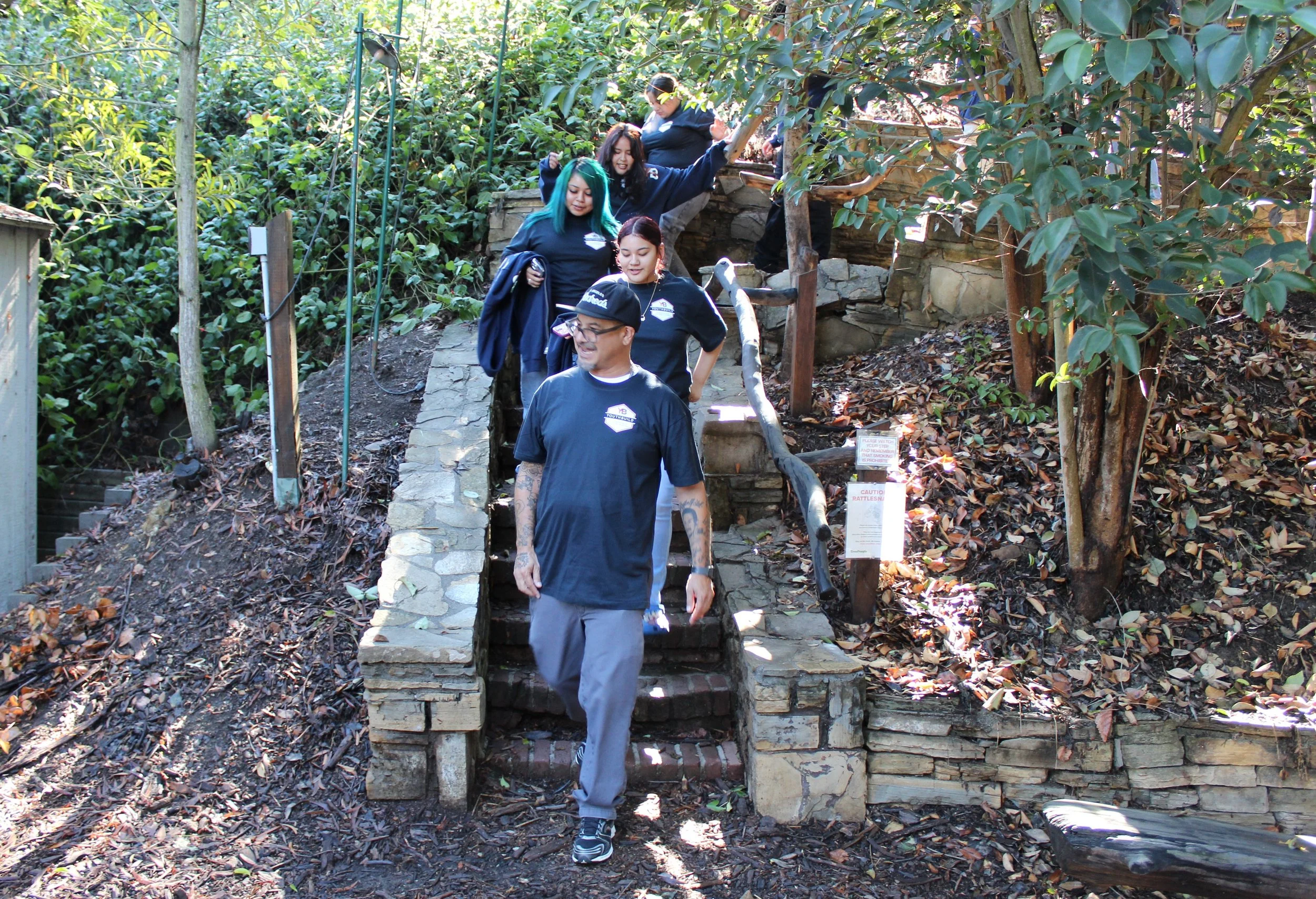
In Fall 2024, YouthBuild convened nearly 50 young leaders for a Youth Policy Council Retreat at TreePeople. Students from across Southern California showed up to share best practices from their programs, identify unmet needs in their communities, learn about policy engagement and leadership pathways, and build relationships across regions and lived experiences.
Their leadership was reinforced through:
Peer-to-peer learning
Hands-on environmental stewardship (planting seeds, hiking)
Reflection on responsibility, not just aspiration
The message was very simple but powerful: your voice matters here and beyond.
why this works
YPC members don’t just attend meetings; they run them. Students regularly:
Facilitate structured meetings with agendas and defined roles
Participate in staff evaluation and hiring conversations
Organize school events, student stores, and community projects
Lead restorative justice circles and conflict resolution
Onboard new members and establish leadership traditions
Over time, youth learn how systems actually work, how to disagree productively, and how to translate lived experience into policy-relevant insight. This builds workforce readiness, civic readiness, and leadership skills.
the outcome
YouthBuild is already seeing stronger program alignment with needs and increased trust between students and staff. Youth who participate in YPCs and similar projects speak with policymakers more confidently, advocate for themselves and their peers more easily, and stay engaged because they have true ownership.
These are the conditions that keep opportunity youth connected, not just enrolled.
If youth don’t have structured ways to lead, the systems that determine their future make blind decisions. And if systems make blind decisions, youth disengagement swells. Once this happens, California loses access to critical talent, stability, and trust in public institutions.
Youth leadership isn’t a soft skill or a resume builder. It’s key infrastructure for effective policy and practice. When opportunity youth have access to shape solutions, government and education programs become more relevant to them, state resources are used more efficiently, and policy reflects actual needs rather than assumptions.
This is how we can scale systems without breaking them.
JOHN MUIR CHARTER SCHOOLS: THE STUDENT LEADERSHIP INITIATIVE
STUDENT VOICE IS NOT A SURVEY. IT’S A GOVERNING PRINCIPLE.
The Challenge
Opportunity youth carry more than most people ever see. They work full-time jobs, care for children and elders, and navigate the daily logistics of meeting basic needs, all while trying to finish school. Traditional institutions too often read these responsibilities as deficits: truancy, low motivation, disengagement.
When systems misread capacity as failure, they make decisions that don’t reflect the actual lives of the students they serve. Programs drift, and trust erodes. And young people who were already navigating extraordinary complexity quietly disappear from school, workforce pipelines, and civic life.
The result is predictable:
Systems spend more energy managing disengagement than building on existing strengths
Student feedback arrives too late, often after decisions are made, and the damage is done
Opportunity youth are talked about in policy rooms they are never invited into
The Intervention
OYSC member, John Muir Charter Schools (JMCS) created a structured, year-long Student Leadership Initiative to do something deceptively simple: ask students what they think, and then do it.
Open to all students across 30+ JMCS sites, the program is built around authentic student voice and real civic participation as a direct feedback mechanism for school improvement. In practice, the initiative looks like this:
Students are selected from across regions through a competitive application process, with the opportunity to earn academic credit
Year-long engagement structured in two phases: building leadership skills in semester one, and identifying real problems and designing solutions in semester two
Weekly sessions developing skills in storytelling, research, design thinking, and collaboration
Moment in Action
The annual student-led conference in Sacramento makes the infrastructure visible.
Students travel together for a multi-day experience that includes presenting solutions to real issues facing their schools and communities, meeting with legislators, and standing before decision-makers in an environment grounded in representation and civic responsibility. For many, it's the first time they’ve been in a room where their experience is treated as evidence.
John Muir’s top administrators were advocates for OY. They were attentive and listened, allowing the students to speak their truth and offering support during crucial conversations.
The following school year, student proposals were implemented across the organization, and JMCS leadership has since credited that conference directly with influencing school-wide goals and initiatives.
Student voice had moved from input to scaffolding actual solutions.
why this works
The JMCS Student Leadership Initiative works because it's designed around the actual strengths of OY, not assumptions.
Students who manage complex, high-stakes responsibilities outside of school already have the capacity for consequential leadership. This program gives them the language, the tools, and the platform to exercise it visibly. Over time, students:
Interview peers and analyze systemic challenges facing their communities
Build and present formal proposals to administrators and policymakers
Earn pathways toward the State Seal of Civic Engagement
Contribute to La Voz, a growing digital publication created by and featuring JMCS students
Mentor peers and model civic engagement for the broader school community
In the end, the result isn’t just student growth but organizational intelligence, too. Schools learn what is actually happening in students’ lives. And students learn how systems work and how to improve them.
the outcome
The impact of the JMCS Student Leadership Initiative is measurable and structural.
At the policy level, student leadership work directly informed JMCS’ Local Control Accountability Plan (LCAP) goals – one of the clearest indicators that student voice has been treated as governance input instead of feedback.
At the program level, participation and engagement have grown across multiple sites, the quality of student work has improved year over year, and a formal pathway to the State Seal of Civic Engagement has been established and is now expanding.
And at the human level, students described stepping into rooms they didn’t think they were allowed in. Staff and community partners, such as Rancho Cielo, Pomona CCC, and LA-CCC Urban Conservation Corps, describe students finding their voice through this work and changing the direction of their lives as a result.
When OY are trusted with responsibility, they rise to meet it. Every time.